
Good Works
On mission for public to give snakes a fair shake
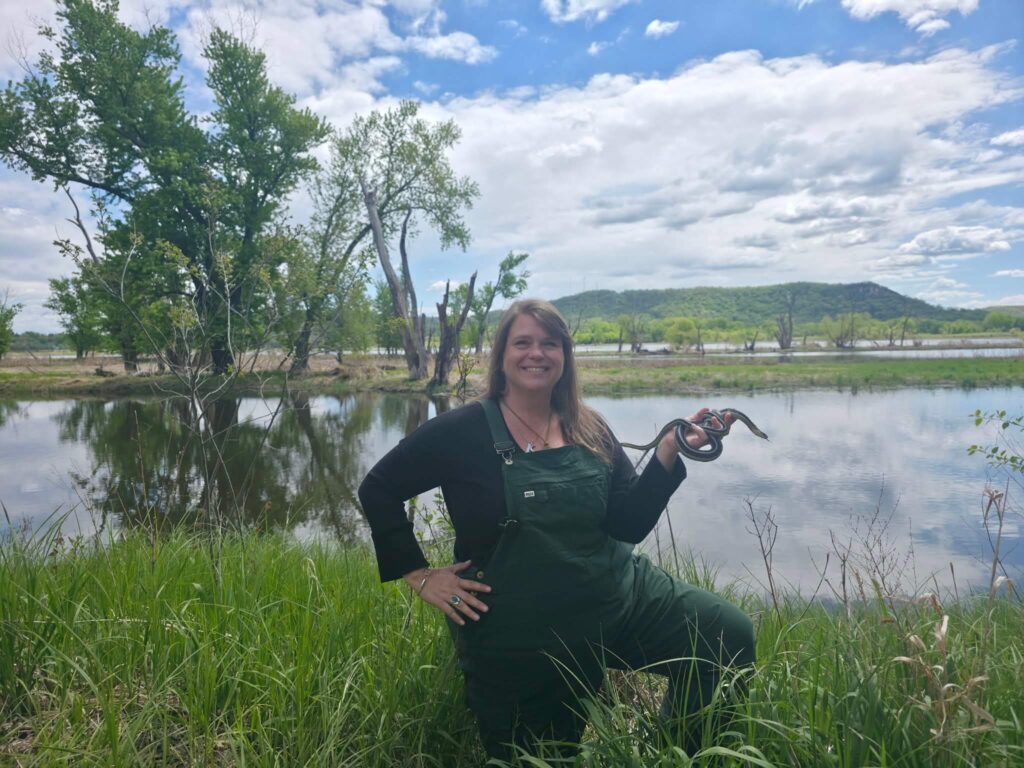
Angela Subjek, founder and executive director of Bluff Country Snakes, poses with Simon and Sunny, paired female garter snakes that accompany the organization on educational programs designed to help people better understand reptiles and reduce fear surrounding some of nature’s most misunderstood animals.
For many people, the sight of a snake is enough to send them sprinting in the opposite direction. Angela Subjek hopes to slow that reaction long enough for curiosity to take hold.
As founder and executive director of Bluff Country Snakes, Subjek introduces people to snakes and other reptiles through educational programs, hands-on experiences and patient conversation. The goal is to reduce fear through education and build appreciation for often-misunderstood animals.
Along the way, Subjek hopes people see how understanding even the creatures we fear can shape the way we see the natural world — and each other.
What inspired you to start Bluff Country Snakes?
I have always loved animals, but what really stayed with me was witnessing fear-based killing of harmless snakes. It made me stop and ask myself: Why are people so afraid, and where does that fear come from?
Soon after that, we got our first snake — and then another, and another. As our interests grew, including my husband’s interest in venomous species, we realized the best path forward was creating an education-focused nonprofit that aligned with local ordinances and Wisconsin DNR licensing requirements.
What started as simply wanting to share our animals with the community has evolved into something much bigger. Bluff Country Snakes has become a space for curiosity, empathy, inclusion, and connection. We are not trying to convince everyone to love snakes; we simply want people to approach the unfamiliar with a little more understanding and a little less fear.
When you first began providing educational programs, what surprised you most about people’s reactions to snakes?
What surprised me most is how capable people are when they are given the opportunity to explore something without judgment, pressure, or shame. We regularly see people walk into our programs terrified of snakes and leave saying, “I never thought I’d do that.”
The fear-reduction stories have been incredibly meaningful, but one thing we did not expect was how strongly some neurodivergent individuals seemed to connect with the animals. We have observed that people with sensory sensitivities or social anxiety often interact with snakes in a very calm, grounding way. There is something about the slow movements, gentle pressure, and quiet nature of these animals that can create a sense of comfort and focus.
How does interacting with ambassador snakes benefit neurodivergent individuals?
We are still learning, but the observations so far have been incredibly encouraging. We have seen individuals who are overwhelmed by loud or highly stimulating environments become noticeably calmer while interacting with ambassador snakes. Some people who struggle with social interaction seem more relaxed and engaged when the focus shifts toward the animal rather than themselves.
Right now, we approach this work with an open mind and a lot of humility and we want to be careful not to overstate what we are seeing. At the same time, we believe there is real value in creating safe, inclusive experiences where people can connect with animals in a gentle and nonjudgmental environment.
What do you hope people carry with them after meeting your ambassador snakes?
Our biggest mission is not to make everyone love snakes. It is to reduce fear-based killing and encourage people to pause and ask themselves, “What else might I be missing out on because of fear?”
Snakes are often judged before people ever have the chance to understand them. In many ways, I think that reflects how humans sometimes treat each other too. Fear and misunderstanding can create distance very quickly.
If someone leaves one of our programs with a little more curiosity, compassion, or willingness to reconsider what they thought they knew, then we have accomplished something meaningful. We hope people walk away realizing that even misunderstood animals have value, purpose, and an important place in our ecosystem — and maybe that empathy matters more than fear.