Answering nature’s call: Local woman protects environment
April 30, 2026
| By La Crosse Community Foundation |
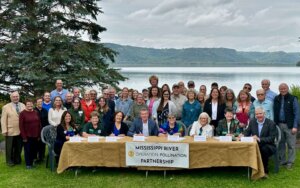
Participants gather in La Crosse on Sept. 28, 2023, for the Mississippi River Operation Pollination Partnership signing, a multi-organization effort to expand pollinator habitat along the Mississippi River corridor. Roz Schnick is seated second from right.
Some people find their calling in a single moment. For Roz Schnick, it began early, and it never let go.
A lifelong advocate for the environment, Schnick has spent decades working at the intersection of science, stewardship and community action. Her work spans local, regional, national, and international efforts, all grounded in a simple idea: The health of our communities is inseparable from the health of the natural world around us.
Today, she continues that work through leadership roles with the Wisconsin Mississippi River Parkway Commission and the Rotary Club of La Crosse, where she helps advance initiatives that protect the Mississippi River corridor and promote pollinator health across communities. Whether she’s collaborating on large-scale environmental partnerships or encouraging small, everyday actions, Schnick brings both urgency and optimism to the work.
What inspired you to get involved with science and the environment?
My dad took me fishing when I was four years old, and that has made all the difference. My mantra is “I have had a wonderful life, and it has just begun.” I have had 59 years of experience in collaborative efforts to (1) mitigate the negative effects of man’s activities on the Upper Mississippi River ecosystem and other large river systems, (2) gain approvals of safe and effective drugs in aquaculture worldwide, (3) gain registrations or reregistrations for safe and effective chemicals for fishery management, (4) address climate change and other environmental issues and (5) pursue community service and philanthropy.
Since the loss of my husband in 2012, I have dedicated the rest of my life to honoring his memory by advocating for access to healthy food, reasonable shelter, adequate healthcare, good educational opportunities, meaningful jobs and careers for economic self-sufficiency and resiliency in a sustainable environment (air, earth, water and energy).
What message would you share with community members about caring for the environment?
April provides us with opportunities to find ways to protect our environment through whatever action suits us. This action could be as simple as planting pollinator plants in a pot on your balcony. It could also mean getting involved with other like-minded people to collaborate on establishing such things as pollinator gardens in your community or reaching out to help educate others on the importance of working together to care for our environment.
It could also mean attending or participating in Earth Day celebrations such as the Sustainability Institute’s 2026 Earth Fair on Sunday, April 26, at Myrick Park and The Nature Place in La Crosse. I am sponsoring a booth that addresses our local environmental activities and beyond. We will be featuring our “Pollinator Parade,” a children’s book written by local author Nick Nichols to get kids (adults too) excited about “bugs” and get them to go outside to explore nature.
What impact do you hope to make with your environmental work?
“No pollinators, no food.” Without pollinators, we have no food. It is as simple as that, and one of the main reasons that caused me to help launch one of the largest and most geographically dispersed Operation Pollination (OP) partnership signings in the world at that time. That partnership is called the Mississippi River Operation Pollination Partnership project and involves the whole Mississippi River corridor from Lake Itasca to the Gulf of Mexico. Signing entities included Rotary International, the Mississippi River Parkway Commission, National Heritage Areas, the City of La Crosse mayor, Environmental Sustainability Rotary Action Group, Operation Pollination, Monarch Joint Venture and Pollinator Partnership.
I hope that this OP initiative will have inspired other entities (companies, organizations and individuals) to make similar efforts to start their own pollinator gardens. My hope is that OP spreads throughout the world so that we can sustain mankind and that no person goes hungry.